What is a mobile top-up?
Por agora, este artigo está em inglês.
Short answer
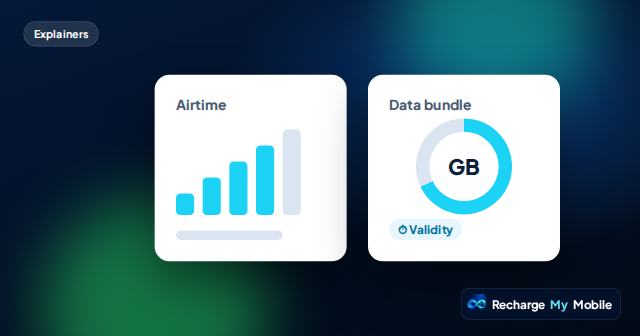
A mobile top-up adds credit to a prepaid phone number, either as airtime (general balance for calls and texts) or as a data bundle (mobile internet for a set period). An international top-up lets you send that credit from one country to a number in another: for example, from the UAE to a parent's phone in Pakistan or the Philippines. The operator credits the number directly, so the recipient doesn't need to do anything to receive it.
Top-up, recharge, reload, load: one idea, many names
Different countries use different words. In India people say recharge, in the Philippines load, in Sri Lanka reload, and in Indonesia pulsa. They all mean prepaid credit added to a mobile number.
On our site we use top-up and recharge. Whatever you call it, the result is the same: the person's operator adds credit to their number, and they can use it as their operator allows.
How does an international top-up work?
You choose the destination country, enter the recipient's number, and choose a product. We pass the order to our supplier, who sends it to the recipient's operator. The operator then credits the number.
You pay in your own currency on a secure payment page. The recipient receives credit in their local currency, or a bundle, on their phone. They don't need a bank account, a card, an app or internet access to receive it.
Airtime or a data bundle?
Airtime is general balance. Depending on the operator, the recipient can use it for calls, texts and sometimes to buy their own package. A data bundle is mobile internet, usually with a validity period, applied straight to the number.
Which one is better depends on how the person uses their phone. Our article on airtime and data bundles goes through the choice in detail.
Who uses international top-ups?
Mostly people living and working away from home who want to help family stay connected. A worker in Dubai might top up a mother's phone in Kerala before a weekly call. A student's relatives might send data for online classes. Someone visiting home might top up their own number before they land.
A top-up is also a small, practical gift. It arrives on the phone itself, so there's no parcel, no voucher and nothing to collect.
What to check before you send
A little care at the start prevents most problems.
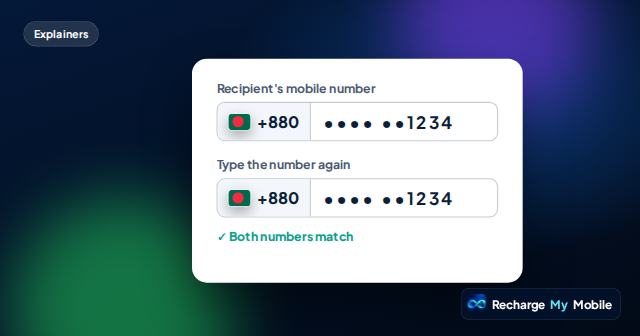
- The country and the full number, including the right country code.
- The operator the number is on now. Numbers can move between networks.
- Whether the number is prepaid. Contract numbers usually can't take prepaid top-ups.
- Which SIM, if the recipient's phone has two.
- Whether they need airtime or data.
What you see before and after paying
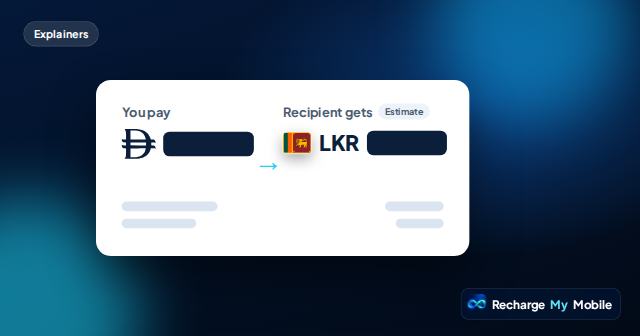
Before you pay, the quote shows You pay, your total including any service fee, and Recipient gets, what lands on the number. It also shows the operator, the country and the number masked so only the last digits are visible. If the received amount can change, it's labelled as an estimate.
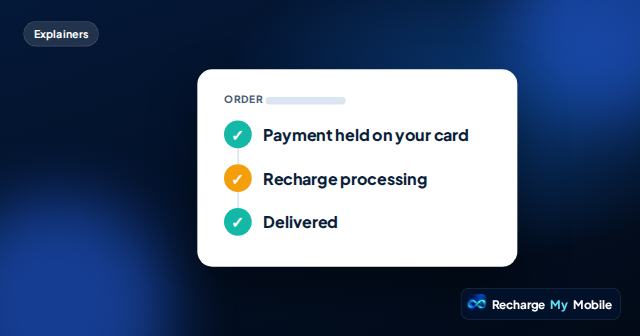
After you pay, the order page tracks two steps separately: payment, then delivery. You'll see Payment held on your card, Recharge processing and then Delivered. If a top-up fails, the hold on your card is released and you aren't charged.
Operators usually credit quickly, but some take longer. If the page says the top-up is still processing, please don't pay again; a second payment would mean a second top-up.
Questions people ask
Is a top-up the same as a recharge?
Yes. Top-up, recharge, reload, load and pulsa are different words for prepaid credit added to a mobile number.
Does the recipient need to do anything to receive a top-up?
No. Their operator credits the number directly. They can check their balance the usual way for their network afterwards.
Can I send a top-up to another country?
Yes. That's what an international top-up is. You pay in your own currency, and the credit arrives on the number abroad.
Can a top-up be cancelled after it's credited?
Usually not. Once the operator has credited a number, a top-up generally can't be reversed, so check the number carefully.