Top-up scams and how to avoid them
Por ahora, este artículo está en inglés.
Short answer
Most top-up scams rely on urgency and trust: a message from a "relative" on a new number, a caller asking for a code, or a site offering deals that look too good. Protect yourself by confirming requests on a number you already know, never sharing one-time codes, paying only on a secure payment page, and checking the number and quote before you pay.
Why scammers like top-ups
Mobile credit is easy to send and hard to take back. A top-up to a wrong number usually can't be reversed once the operator has credited it. Scammers know this, so they try to get you to send credit, or share details, before you have time to think.
The good news is that a few calm habits stop nearly all of these tricks. You don't need technical knowledge, only a pause before you act.
Common scams to watch for
These patterns turn up again and again, in many countries and languages.
- "I've lost my phone, this is my new number, please send credit."
- A caller claiming to be from a network or bank, asking you to read out a code you just received.
- A message saying you won a prize and must top up a number to claim it.
- Someone asking you to top up their number in exchange for a cash payment later.
- Websites or social media pages promising unusually large amounts of credit for very little.
- Fake "support" contacts asking for your card details to fix an order.
The pause-and-check habit
When any request involves credit, codes or payment, pause. Ask yourself: do I know this number? Did I expect this message? Is someone rushing me?
If anything feels off, contact the person on a number you already have, or ask someone close to them. Genuine relatives won't mind a quick check. Scammers usually disappear when you slow down.
Never share codes or card details
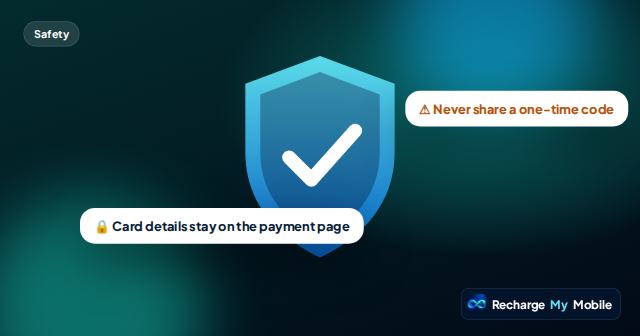
One-time codes sent by text are meant for you alone. Anyone who asks you to read one out, even if they sound official, is a warning sign. Sharing a code can let someone take over an account or approve a payment.
On our site, payment happens on a secure payment page. Card details never pass through our site or the Recharge Guide assistant, and we will never ask you for them by message, phone or chat.
How our process helps protect you
You type the recipient's number twice, so a typo can't send credit to a stranger. We check the number's format and, where available, its operator. If we can't confirm the operator, you choose it; we never guess.
The quote shows the operator, the country and the number masked as ••••1234, together with "You pay" and "Recipient gets". If something in that summary doesn't match what you expected, stop before paying.
If you think you've been caught out
Act quickly. If you shared card details, contact your bank or card provider straight away. If you shared a code, contact the service it belongs to.
If you sent a top-up because of a scam, open your order page and contact us. A credited top-up usually can't be reversed, but we can check what happened with our supplier and help you understand your options.
Questions people ask
How do I know if a top-up request from a relative is real?
Call the relative on the number you already know, or check with someone close to them. Requests from new numbers are a common scam.
Can a scammer get my money back from a top-up?
A credited top-up stays on the number it was sent to and usually can't be reversed. That's why checking the request first matters so much.
Will you ever ask for my card details by message?
No. Payment happens only on the secure payment page. We never ask for card details by message, phone or chat.
What should I do if I shared a one-time code?
Contact the service the code belongs to straight away, such as your bank, and follow their advice. Change passwords if needed.