Exchange rates and estimated amounts, in plain words
இந்தக் கட்டுரை தற்போது ஆங்கிலத்தில் உள்ளது.
Short answer
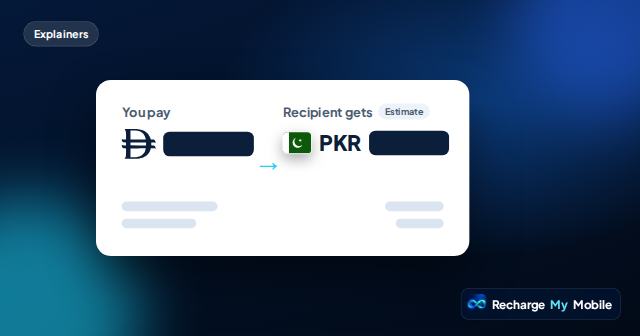
When you pay in one currency and the recipient receives credit in another, the amount that arrives can depend on exchange rates and on the operator's own rules. Where it can change, we label the Recipient gets figure as an estimate rather than presenting it as exact. Your You pay figure is fixed for the life of the quote, and if the quote expires, we fetch a fresh one rather than charging an old price.
நீங்கள் செலுத்துவது
AED 2.72
- ஏர்டைம்
- AED 1.72
- சேவைக் கட்டணம்
- AED 1.00
 பெறுநர் பெறுவது மதிப்பீடு
PKR 88.89
டாப்-அப் PKR 100.00, ஆப்பரேட்டர் கழிக்கும் 11.11% AIT போக
Why currency conversion matters
You might pay in AED and your mother in Egypt receives credit in EGP. Somewhere between the two, the value is converted. Exchange rates move during the day, and the rate used can depend on when the operator processes the top-up.
For many products the received amount is set in advance and doesn't change. For others, it can move a little. We label the second kind as an estimate.
Operator rules can matter too
Operators can apply their own rules when they credit a number: a tax required by local authorities, a change to a product, or a promotion that adds or changes what's included. Where our supplier tells us about these, we show them on the quote.
If a recipient wants to understand exactly what landed on their account, their operator can show them.
What stays fixed and what doesn't
It helps to separate the two sides of the quote.
- You pay is fixed for that quote. It's what you'll be charged.
- Recipient gets is either fixed or clearly labelled as an estimate.
- Every quote has an expiry time. After it, a fresh quote is fetched.
- We never charge an expired quote.
Why not just promise an exact figure?
Because it wouldn't always be true. If we showed an exact received amount for a product where it can move, we'd be guessing on your behalf. Labelling it as an estimate is the honest way to show it.
For products where the supplier verifies the received value, we show it without the estimate label.
A simple example, without the numbers
Imagine you pay in dirhams for airtime in Bangladesh. Your quote shows You pay in AED and Recipient gets in BDT, labelled as an estimate. You pay within the quote's time, and you're charged exactly the AED total you saw.
When the operator credits the number, the recipient sees a balance close to the estimate. It may be a touch higher or lower, depending on the rate applied at that moment. If you'd waited until the quote expired, the page would have shown you a fresh quote first, with new figures to check, before taking any payment.
Now imagine a data bundle instead. Here the recipient gets the bundle as the operator describes it, so exchange rates don't change what they receive; they only affect what the bundle costs you, which is fixed on your quote.
What you can do
A few habits help when the received amount matters.
- Read the Recipient gets figure and check whether it says estimate.
- If the recipient needs a particular balance, choose a product with a fixed received amount if one fits.
- Pay within the quote's time; if it expires, read the fresh quote before continuing.
- Tell the recipient roughly what to expect, so a small difference doesn't worry them.
Questions people ask
Why is the received amount an estimate?
Because it can change with exchange rates or operator rules between the quote and the moment the operator credits the number.
Can the amount I pay change after I confirm?
No. You pay is fixed for that quote. If the quote expires, a fresh one is shown before you can pay.
Will the recipient get more or less than the estimate?
It may differ slightly either way. If the difference seems large, open a case from the order page so we can check.
Which currencies can I pay in?
You can pay in several currencies, including AED, SAR, QAR, KWD, BHD, OMR, USD, EUR and GBP.