Urgent messages asking for credit: how to check they're real
මෙම ලිපිය දැනට ඉංග්රීසියෙන් ඇත.
Short answer
Before sending credit in response to an urgent message, check it's real: call the person on the number you already know, or ask someone close to them. Be especially careful if the message comes from a new number, asks you to hurry, or asks for a code. A top-up to the wrong number usually can't be reversed, so a short check is worth it.
Why these messages work
Urgent requests play on love and worry. A message that says "Mum, my phone broke, this is my new number, please send credit now" is designed to make you act before you think. Scammers send thousands of these, hoping a few land with someone who has a relative abroad.
They don't need to know much about you. A common name, a family word such as "Mum" or "Bhai", and a sense of urgency are often enough. That is why checking matters, even when the message feels personal.
Warning signs to look for
One sign on its own doesn't prove a scam, but several together should make you stop.
- The message comes from a number you don't recognise.
- The sender says they can't talk on the phone right now.
- You are asked to hurry, keep it secret or not tell other family members.
- The amount or the number to top up keeps changing.
- You are asked to share a code that just arrived on your phone.
- The writing style doesn't sound like the person you know.
How to check in a minute
Call the person on the number you already have for them. If they answer, you'll know at once. If they don't, try someone close to them: a parent, sibling, partner or friend who can confirm.
You can also ask a question only the real person would know, such as something from a recent family event. Avoid questions with answers anyone could find on social media.
If it turns out to be real
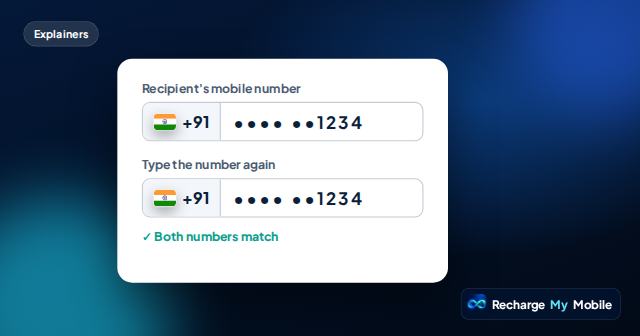
Sometimes the request is genuine. People do lose phones and get new numbers. Once you have confirmed it, ask them to send the new number in writing, and type it twice on our form. The two entries must match.
We check the number's format and, where available, its operator. If we can't confirm the operator, you choose it; we never guess. Then read the quote: it shows the country, the operator and the number masked as ••••1234, so you can check it one last time.
If you've already sent credit
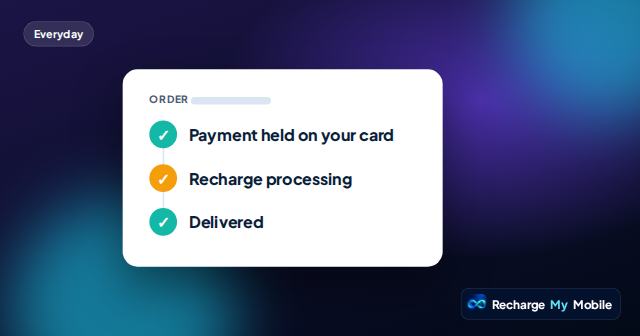
If you realise after paying that the request was fake, open your order page. If the top-up is still processing, contact us from there. A top-up that has already been credited usually can't be reversed, but we will check with our supplier.
Warn other family members, because the same scammer may try them next. If the message came through a hacked account, encourage the real owner to secure it.
Agree a family rule
The simplest protection is a family agreement: any request for credit or money from a new number gets a phone call first. Nobody will be offended, and scammers lose their best tool, which is speed.
Share this rule with older relatives too, who may be targeted with similar messages pretending to be you.
Questions people ask
My relative messaged from a new number asking for credit. Is it a scam?
It might be. Call your relative on the number you already know, or check with someone close to them, before sending anything.
Can I get my money back if I topped up a scammer's number?
Once the operator has credited the top-up, it usually can't be reversed. Contact us from the order page and we will check what happened.
Why do scammers ask for phone credit instead of money?
Credit is quick to send and hard to reverse, and people may think of it as a small favour. Some scams also try to get codes at the same time.
How can I protect my parents from these messages?
Agree that any request from a new number gets a phone call first, and remind them never to share codes that arrive by text.
Should I reply to the suspicious message?
It is safer not to engage. Contact the real person on the number you already know instead, and warn others in your family.